

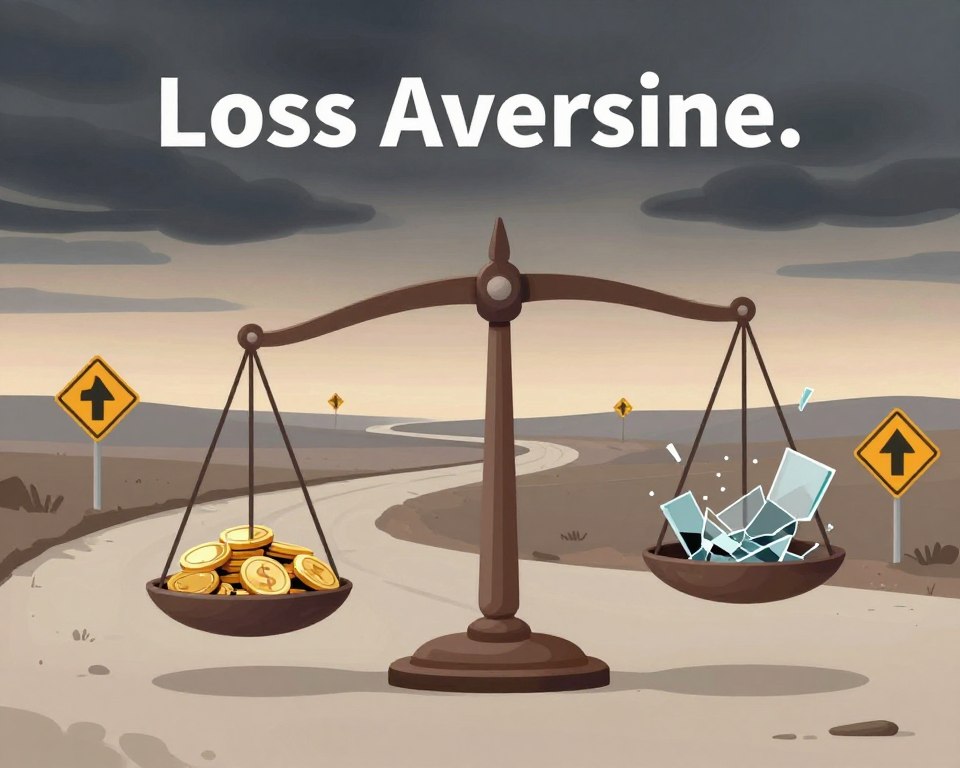
Research suggests people feel the pain of a financial setback about twice as intensely as the pleasure from an equal gain. This powerful emotional response is a core part of a common mental shortcut known as loss aversion.

Loss aversion is a type of cognitive bias from behavioral economics. It describes the tendency to strongly prefer avoiding losses over acquiring equivalent gains. For individuals managing their portfolios, this means the fear of a downturn can feel much stronger than the hope for growth.
This bias can significantly impact financial choices. It may cause someone to hold onto a declining asset for too long or avoid necessary risks. Recognizing this instinct is the first step toward making more balanced decisions. Understanding these emotional drivers is crucial for long-term success.
Key Takeaways
- Loss aversion is a mental bias where potential losses feel more significant than equal gains.
- This tendency originates from behavioral economics and influences many financial decisions.
- The emotional impact of a loss is often psychologically much heavier than the joy from a win.
- This bias can lead to overly cautious behavior, like holding underperforming assets.
- Awareness of this bias is essential for investors at any level of experience.
- Recognizing this pattern helps people separate emotions from logical portfolio management.
Understanding Loss Aversion
Cognitive research shows that people’s emotional responses to financial outcomes are asymmetrically weighted toward negative events. This fundamental psychological pattern influences many aspects of personal finance and economic behavior.
Definition and Core Concepts
This behavioral tendency describes how individuals perceive setbacks as more significant than equivalent advances. The core concept centers on people’s strong preference for protecting against negative outcomes rather than pursuing positive ones.
Studies indicate the emotional distress from a financial setback is approximately twice as powerful as the satisfaction from an equivalent gain. This disproportionate response creates significant implications for financial decision-making.

| Financial Event | Emotional Response | Relative Intensity |
|---|---|---|
| $100 Gain | Satisfaction | 1x (Baseline) |
| $100 Setback | Distress | Approximately 2x |
| Potential Gain | Hope/Caution | Variable |
| Potential Setback | Fear/Avoidance | Consistently High |
Psychological Impact in Finance
In financial contexts, this tendency manifests when people make choices driven by protective instincts rather than rational analysis. The emotional weight assigned to potential negative outcomes can override logical assessment of opportunities.
This psychological pattern helps explain why traditional economic models of rational decision-making often fail to predict actual behavior. Understanding these emotional drivers is crucial for developing more effective financial strategies.
The disproportionate focus on protection represents a key challenge for individuals seeking balanced financial outcomes. Recognizing this inherent tendency allows for more conscious and deliberate decision-making processes.
How Does Loss Aversion Work
This psychological phenomenon functions through specific cognitive processes that researchers have systematically documented. The framework explains why financial choices often deviate from purely rational models.
Origins from Prospect Theory
Psychologists Daniel Kahneman and Amos Tversky developed prospect theory in the late 1970s. Their work challenged traditional economic assumptions about decision-making.
Kahneman received the Nobel Prize in Economics in 2002 for this groundbreaking research. The theory demonstrated that people feel setbacks more intensely than equivalent advances.

Emotional Decision-Making in Investing
In financial contexts, this tendency influences how individuals approach risk and potential gains. Investors often prioritize fear of negative outcomes over rational assessment.
This emotional pattern can lead to asymmetric volatility in markets. During declines, market volatility increases more sharply than during equivalent rises.
Understanding these mechanisms helps explain why people hold declining assets too long. They hope for recovery while quickly selling winners to lock in returns.
Characteristics of Loss Aversion Theory
Several key mechanisms define how this behavioral tendency operates in decision-making contexts. The theory reveals distinct patterns that explain why people often make irrational financial choices.
Asymmetric Value Perception
This core characteristic shows that potential setbacks carry more psychological weight than equivalent advances. People feel the impact of negative outcomes about twice as strongly as positive ones.
The imbalance creates significant challenges for balanced financial evaluation. Individuals may reject favorable opportunities due to exaggerated fear of potential losses.
Status Quo Bias and the Endowment Effect
Status quo bias describes the preference for maintaining current circumstances. People often resist changes because they perceive them as potential losses rather than opportunities.
The endowment effect causes individuals to overvalue possessions they already own. This inflation of perceived value makes it difficult to make objective decisions about current holdings.
These characteristics interact to create predictable patterns in financial behavior. Understanding them helps people recognize when emotions override logic. Recognizing these patterns is the first step toward more balanced decision-making.
Key characteristics include:
- Imbalanced evaluation of gains versus setbacks
- Resistance to altering current circumstances
- Overvaluation of owned assets
- Context-dependent risk attitudes
Risks and Consequences of Loss Aversion
This behavioral pattern creates measurable risks that can undermine long-term financial success. The tendency to prioritize protection over opportunity leads to several predictable negative outcomes.
Impact on Investment Decisions
The psychological preference for avoiding setbacks distorts rational evaluation. People may hold declining assets too long, hoping for recovery.
They might also sell winning positions prematurely. This approach locks in small gains but misses larger growth potential.
| Consequence Type | Behavioral Pattern | Financial Impact |
|---|---|---|
| Suboptimal Choices | Holding losing positions | Reduced portfolio returns |
| Missed Opportunities | Avoiding sound investments | Lower growth potential |
| Premature Exits | Selling winners too early | Limited profit capture |
Emotional Stress and Opportunity Costs
Constant focus on potential setbacks creates significant anxiety. This emotional burden can impair judgment and decision-making quality.
The avoidance of reasonable risks results in invisible costs. These missed chances accumulate over time, affecting long-term performance.
Market participation becomes inconsistent when fear dominates strategy. A balanced approach considers both protection and growth potential.
Practical Strategies for loss aversion bias investing
Several practical methods help create a more balanced approach to evaluating financial outcomes. These techniques address the emotional component of decision-making while maintaining logical assessment.
Reframing Decisions and Setting Reference Points
Changing how choices are presented can significantly influence outcomes. Focusing on potential gains rather than possible setbacks helps counter emotional responses.
Establishing clear benchmarks provides objective measurement. Comparing performance to market indices offers balanced perspective. This approach reduces subjective emotional weighting.
Long-Term Focus and Systematic Processes
A extended time horizon normalizes short-term fluctuations. It places temporary setbacks within broader context of long-term objectives.
Systematic tools like decision matrices remove emotion from choices. Automatic mechanisms such as stop-loss orders prevent emotional attachment to declining positions.
Effective strategies include:
- Consulting with objective third parties for perspective
- Implementing rule-based portfolio rebalancing
- Using analytical tools for rational assessment
Combining multiple approaches creates the most robust framework for balanced financial management.
Conclusion
Behavioral finance offers a crucial lens for interpreting market movements and individual financial choices. This field provides scientific insights into why investors sometimes act against their own rational interests.
Understanding concepts like loss aversion bias is fundamental. It explains the tendency to fear financial setbacks more than we value equivalent gains. This knowledge helps people recognize their own decision-making patterns.
Awareness of this cognitive bias is the first step toward improvement. Investors can then apply practical strategies to achieve more balanced outcomes. The goal is rational assessment of both risk and potential.
Research in this area empowers individuals to make more informed decisions over time. A long-term perspective and systematic approach are key tools for managing this natural tendency effectively.
FAQ
What is loss aversion bias in simple terms?
How can loss aversion impact my portfolio performance?
Are there practical methods to overcome loss aversion?
Does loss aversion only affect new investors?
What is the connection between loss aversion and risk tolerance?
