
What if the most important decision for a multi-billion dollar pension fund is the same fundamental choice every individual investor faces? This process determines how vast sums of capital flow through global markets.

Institutional asset allocation is the strategic distribution of capital by large organizations. These entities include pension plans, sovereign wealth funds, and insurance companies. Their goal is to meet specific long-term financial objectives.
This approach to managing a portfolio is far more complex than individual investing. The sheer scale, regulatory oversight, and diverse liabilities create a unique challenge. These investors collectively control over $70 trillion globally.
Their choices significantly influence world economies. This guide explores the core principles of this critical investment function. We will examine the strategies and considerations that shape these major financial decisions.
Key Takeaways
- Institutional asset allocation is how large organizations distribute their capital across different types of investments.
- These investors manage enormous sums of money, giving their decisions a major impact on global markets.
- The process is more complex than individual investing due to scale, regulations, and specific long-term goals.
- Proper allocation is widely considered the primary factor driving long-term portfolio performance.
- Understanding these principles provides insight into the mechanics of the global financial system.
Introduction to Institutional Asset Allocation
Large organizations follow a systematic process to distribute their capital. This process is known as institutional asset allocation. It involves dividing funds across various investment opportunities to meet long-term goals.
These major investors manage money on behalf of groups or individuals. Their responsibilities often extend to future generations. This requires a disciplined and forward-looking approach to portfolio management.

The landscape of these entities is vast and varied. They control trillions of dollars in global assets.
- Pension plans: These represent the largest group, managing approximately $35 trillion. This sum accounts for roughly half of all institutional assets worldwide.
- Sovereign wealth funds: These entities control about $7 trillion in government-owned capital. They focus on long-term national objectives.
- Endowments and foundations: They oversee $1.6 trillion to support universities, charities, and other non-profit organizations.
- Banks and insurance companies: They hold around $9 trillion in net financial assets. Their allocation strategies must balance risk to meet customer obligations.
Each type of institution faces distinct investment challenges. Their specific mandates and stakeholder needs shape their unique strategies and constraints.
Understanding Institutional Investors and Their Roles
Major financial entities operate with distinct mandates that guide their investment approaches. These organizations manage capital for specific purposes and answer to various stakeholders.
Types of Institutional Investors
Pension funds come in two main forms. Defined benefit plans guarantee specific retirement payments. The employer bears the investment risk. Defined contribution plans shift decisions to individual participants.
Sovereign wealth funds are government-owned investment vehicles. They often manage national resource revenues. Endowments and foundations support charitable missions with perpetual or finite timelines.
Banks and insurance companies act as financial intermediaries. They balance complex portfolios to meet customer obligations while generating adequate returns.
Common Investment Challenges
These investors face multiple constraints. Regulatory requirements and accounting standards shape their strategies. They must balance stakeholder interests while managing liability streams.
Liquidity needs and risk capacity vary by institution type. Each organization’s mandate determines its unique investment challenges. Time horizons and obligation nature influence their approach.
Legal structures and governance frameworks create additional considerations. Tax implications and reporting standards affect portfolio decisions. These factors collectively shape how large funds operate.
Overview of Asset Allocation Strategies
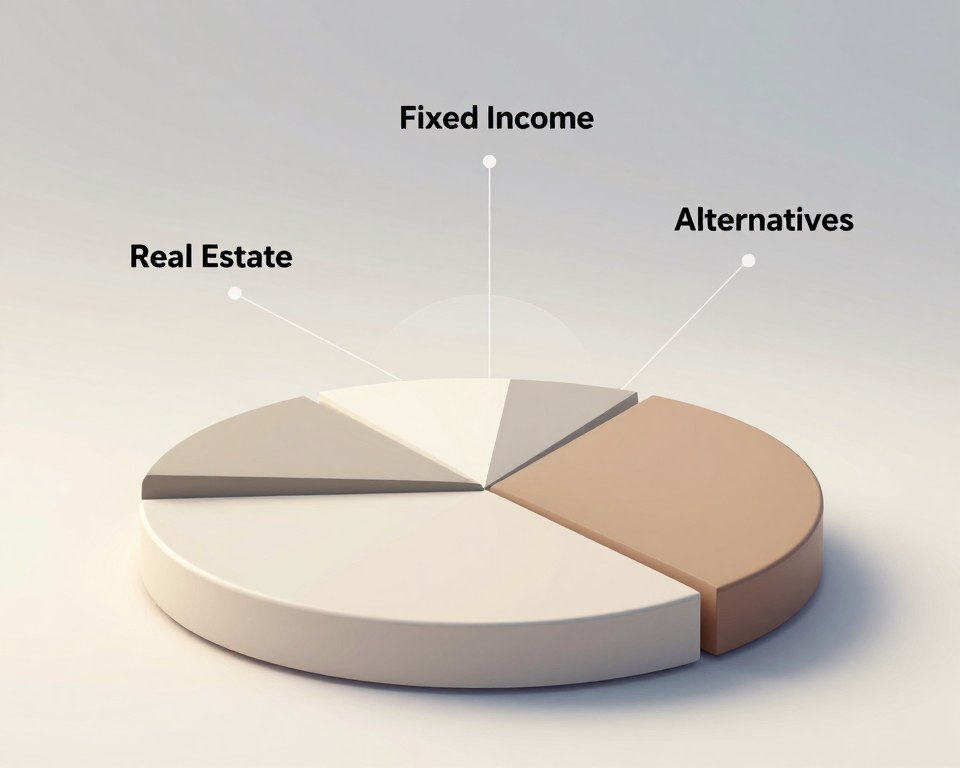
Investment strategies for large portfolios typically involve dividing funds among three primary categories to achieve balanced returns. This approach helps manage risk while pursuing growth objectives.
Equity, Fixed Income, and Alternatives
Portfolio construction relies on three main investment types. Equity investments represent ownership in companies. They offer growth potential through stock appreciation.
Fixed income securities provide regular interest payments. These include government and corporate bonds. They add stability to investment portfolios.
Alternative investments cover non-traditional options. Private equity and hedge funds fall into this category. Real estate and infrastructure are also common alternatives.
Historical Shifts in Allocation Trends
Investment approaches have evolved significantly over decades. The 1970s saw conservative strategies focused on domestic bonds. Portfolios were simple and risk-averse.
The 1980s introduced the classic 60/40 balanced approach. This mixed equity and fixed income in standard proportions. It became a benchmark for many funds.
International diversification gained prominence in the 1990s. Investors recognized global markets offered reduced risk. Geographic spread became a key strategy.
Since 2000, alternatives have grown in importance. Private equity and real estate allocations increased substantially. This reflected search for higher returns and diversification.
| Decade | Primary Focus | Key Development | Typical Allocation |
|---|---|---|---|
| 1970s | Domestic Fixed Income | Conservative Approach | 90% Bonds, 10% Other |
| 1980s | Balanced Portfolio | 60/40 Standard | 60% Equity, 40% Fixed Income |
| 1990s | International Diversification | Global Markets | 50% Domestic, 30% International, 20% Fixed Income |
| 2000s+ | Alternative Investments | Private Assets | 40% Equity, 30% Fixed Income, 30% Alternatives |
Institutional Asset Allocation: Process and Guidelines
Major capital deployment decisions stem from a structured methodology that balances long-term vision with short-term opportunities. This systematic process establishes clear guidelines for distributing funds across various investment categories.
Strategic vs. Tactical Approaches
Strategic asset allocation defines the long-term target mix for an investment portfolio. This approach establishes policy weightings that typically remain stable over multi-year periods.
The strategic framework considers return objectives, risk appetite, and various constraints. Institutions develop core investment beliefs that guide their strategic management plan.
Tactical allocation involves short-term deviations from strategic targets. Portfolio managers use this approach to capitalize on market opportunities or manage emerging risks.
Tactical decisions operate within defined ranges around strategic benchmarks. This active management technique aims to add value beyond the strategic plan.
Most organizations use a combination of both approaches. Strategic allocation drives the majority of long-term returns. Tactical adjustments provide flexibility within the overall investment strategy.
Effective capital deployment requires clear documentation in policy statements. Regular review processes ensure the allocation approach remains aligned with organizational objectives.
Investment Policy Statements and Their Components
A formal document governs the long-term strategy for managing a large investment portfolio. This document is the investment policy statement (IPS). It serves as a written agreement between all stakeholders.
The IPS establishes clear guidelines and responsibilities. It ensures everyone involved understands the investment objectives and the framework for achieving them.
Key Elements of an IPS
Every comprehensive policy statement contains several core components. These elements provide a complete roadmap for the portfolio plan.
Clearly defined objectives specify the target performance. The document also outlines long-term percentage targets for different investment types.
Risk parameters and time horizons are clearly stated. Liquidity needs and spending requirements are also detailed. A strong governance section identifies decision-makers and their roles.
| IPS Component | Primary Purpose | Example Detail |
|---|---|---|
| Return Objectives | Define performance targets | 7% annual return over 10 years |
| Policy Targets | Set long-term investment mix | 60% Global Equity, 30% Fixed Income, 10% Alternatives |
| Risk Parameters | Establish risk tolerance limits | Maximum 15% annual loss threshold |
| Governance Framework | Clarify roles and responsibilities | Investment committee approves strategy changes |
Review and Update Frequency
A static investment policy can become outdated. Markets and organizational needs change over time.
The IPS should be reviewed at least annually. This ensures the plan stays aligned with current conditions. Any changes require formal approval and documentation.
This regular review process maintains accountability. It also preserves institutional memory for future decision-making.
Risk and Return Considerations in Asset Allocation
Every investment decision fundamentally involves a trade-off between potential reward and potential loss. For large portfolios, this balance is formalized through clear objectives and tolerance levels. The goal is to achieve necessary returns without exceeding acceptable risk.
Growth-oriented investments, like equities, typically offer higher expected returns. However, they also introduce significant price volatility. Conversely, high-quality fixed income and cash provide stability but usually generate lower long-term value.

Risk Tolerance and Expected Shortfall
An organization’s risk tolerance defines the maximum loss it can withstand. This is measured using several metrics. Volatility shows how much a portfolio‘s value fluctuates.
Value at Risk (VaR) estimates potential loss over a set time. A more advanced metric is Conditional VaR (CVaR), or expected shortfall. CVaR calculates the average loss in worst-case scenarios, offering a clearer view of tail risk.
Portfolio Diversification Methods
Diversification is a core strategy for managing risk while pursuing return objectives. It involves spreading investments across different asset classes.
These classes should have different return drivers. They perform differently in various market environments. This approach reduces overall portfolio volatility and helps maintain more stable returns over time.
Asset Classes in Institutional Portfolios
Different investment categories offer unique risk-return profiles that serve specific portfolio objectives. These distinct asset classes form the building blocks of any comprehensive investment portfolio strategy.
Each category plays a specialized role in achieving balanced outcomes. Public equity provides growth potential through company ownership. Fixed income investments like government bonds offer stability and predictable income streams.
Comparing Public and Private Investments
The distinction between public and private markets centers on liquidity, transparency, and return expectations. Public investments trade on exchanges with daily pricing. Private funds involve longer holding periods and limited liquidity.
Private equity has historically delivered higher returns than public benchmarks. This illiquidity premium compensates investors for locking up capital. Cambridge Associates data shows consistent outperformance across multiple time horizons.
Real estate and infrastructure assets provide inflation protection through tangible property ownership. These classes generate stable cash flows with inflation-linked characteristics. They add diversification beyond traditional stock and bond markets.
Private debt strategies offer returns driven by credit analysis rather than market movements. The dispersion between top and bottom performing funds is significantly wider in private investing. This makes manager selection critical for capturing value in these alternative asset classes.
Integrating ESG and Return Objectives
Environmental, social, and governance factors are reshaping how major investors approach their long-term financial goals. These considerations appear in policy documents at two distinct levels.
The first level involves governance principles that guide engagement with portfolio companies. This includes voting policies and shareholder advocacy approaches. The second level concerns investment implementation through universe definitions and manager selection.
ESG Considerations in Investment Objectives
Some organizations view ESG integration as secondary to their primary mandate of generating returns. They prioritize financial performance for stakeholders above sustainability metrics.
ESG-compliant investments do not constitute a separate category requiring strategic decisions. Green bonds, for example, exhibit similar risk characteristics to traditional bonds.
Strategic approaches should focus on asset class decisions while ESG implementation occurs at more granular levels. The transition to Net Zero carbon emissions creates economic costs that may affect growth prospects.
These transition costs could reduce corporate profit margins and potentially degrade expected returns. Institutions should reassess their objectives as climate policy effects become clearer in long-term planning.
The debate continues about whether ESG factors enhance or compromise investment outcomes. Different perspectives exist on how deeply these considerations should influence portfolio construction.
Managing Liquidity and Spending Needs
Cash flow management stands as a critical component in the strategic deployment of large investment pools. Different investment categories provide varying liquidity levels, from immediate cash access to long-term commitments.

Even publicly traded securities should not serve as primary liquidity sources. Selling during market downturns can permanently impair capital. Organizations must forecast cash requirements carefully.
Spending policies govern annual withdrawals from investment portfolios. Higher spending rates require greater returns to maintain purchasing power. This relationship affects volatility tolerance.
The proportion of operating budget funded by portfolio distributions significantly influences risk levels. Entities with low dependence can accept more volatility. Heavy reliance requires balanced approaches.
| Liquidity Level | Asset Examples | Appropriate Use | Time Horizon |
|---|---|---|---|
| Immediate | Cash, Money Markets | Operating Expenses | 0-3 Months |
| Short-term | Government Bonds | Debt Service | 3-12 Months |
| Medium-term | Public Equities | Capital Expenditures | 1-3 Years |
| Long-term | Private Investments | Growth Objectives | 5+ Years |
Maintaining sufficient liquid reserves avoids forced selling during stress periods. Planning alternative funding sources provides additional flexibility. This approach preserves long-term value.
Tailoring Asset Allocation for Different Institutional Types
The specific characteristics of each major investor type dictate unique portfolio construction methods. Organizations customize their investment approaches based on distinct mandates and operational requirements.
This customization ensures alignment with each entity’s financial goals and stakeholder expectations. The approach varies significantly across different categories of money managers.
Pension Funds and Endowments
Retirement systems consider their funded status when making investment decisions. They compare current portfolio values against future payment obligations.
Sponsor financial strength directly impacts risk tolerance levels. Stronger organizations can support more aggressive strategies. Weaker entities typically require conservative approaches.
Educational endowments often employ the Yale Model pioneered by David Swensen. This strategy emphasizes alternative investments and skilled manager partnerships.
These funds accept higher illiquidity due to predictable spending patterns. Their perpetual time horizons support intergenerational equity objectives.
Sovereign Wealth Funds and Insurers
Government investment vehicles employ innovative approaches with active management. They seek value beyond basic policy benchmarks.
Insurance companies balance returns with regulatory capital requirements. They match investment durations to policy liability timelines.
Life insurers prioritize annual accounting income as their main objective. They combine bond portfolio income with other investment returns.
| Investor Type | Primary Focus | Key Consideration | Typical Approach |
|---|---|---|---|
| Pension Funds | Liability Matching | Funded Status | Risk-Adjusted Returns |
| Endowments | Perpetual Growth | Spending Rates | Alternative Heavy |
| Sovereign Funds | National Objectives | Funding Source | Active Management |
| Insurance Companies | Capital Requirements | Duration Matching | Income Generation |
Effective capital distribution requires understanding each organization’s unique constraints. The right mix depends on specific mandates and stakeholder needs.
Conclusion
Understanding how large-scale capital stewards construct their holdings offers valuable insights into the mechanics of global finance. This systematic process for distributing funds is the primary driver of long-term performance for these major investors.
Effective strategies require a careful balance. They must weigh return objectives against risk tolerance and specific operational needs. This balance is unique to each type of organization, from pension funds to sovereign wealth funds.
The framework for these decisions is formalized in documents like an investment policy statement. This ensures disciplined management aligned with clear goals. For anyone building an investment portfolio, these principles of disciplined asset allocation provide a foundational model.
Ultimately, successful long-term investment hinges on a structured, thoughtful approach. This guide has outlined the core concepts that guide institutional investors in their critical work of capital stewardship.
FAQ
What is the primary goal of institutional asset allocation?
How do investment policy statements guide the allocation process?
What are the key differences between strategic and tactical allocation?
Why is diversification critical in an institutional portfolio?
How do institutions incorporate ESG factors into their strategy?
What role does liquidity play in managing these portfolios?
How often should an institution review its asset allocation?
